

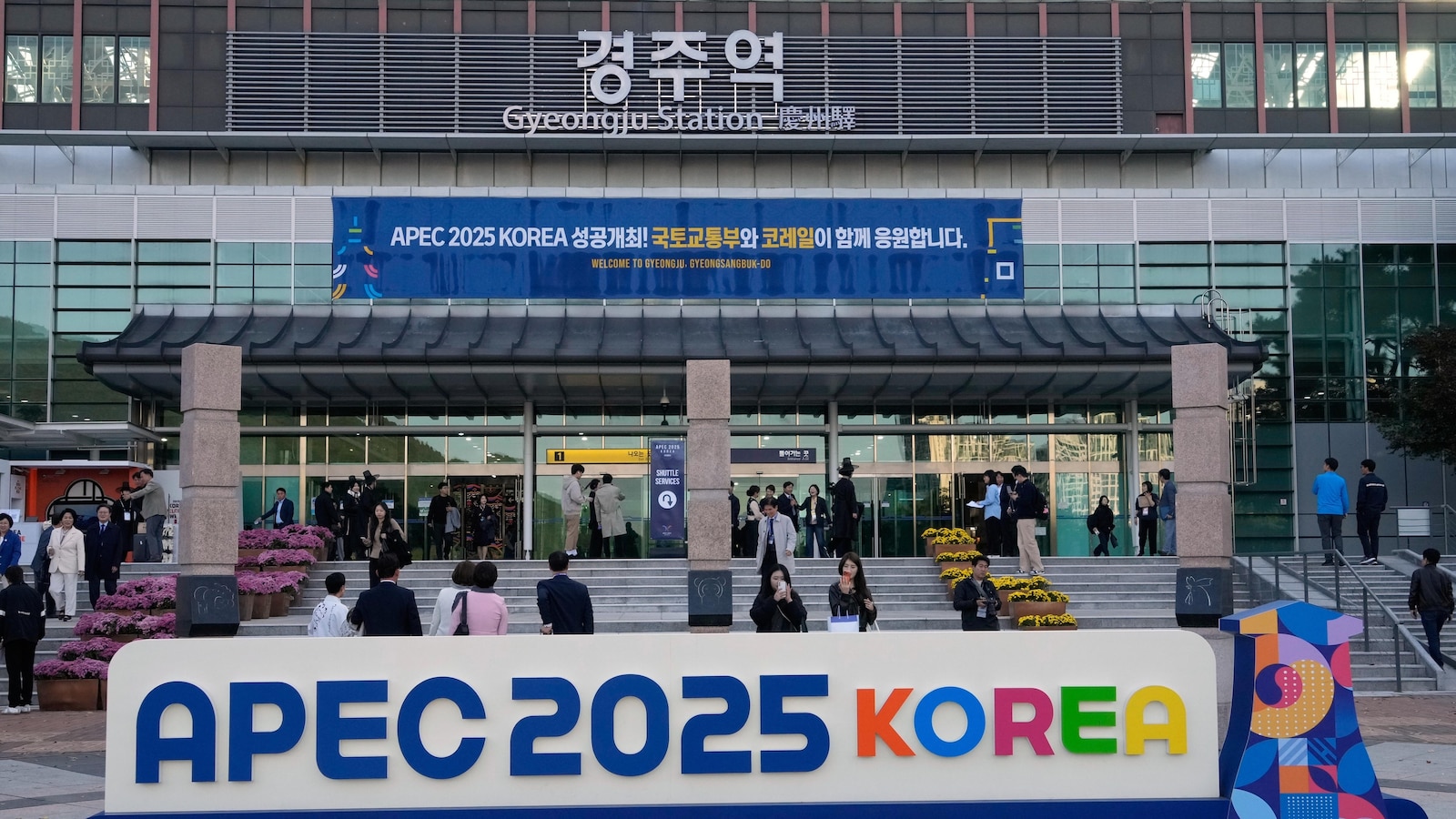
Gyeongju, South Korea — Leaders of 21 countries in the Asia-Pacific Rim are scheduled to conclude their annual economic forum on Saturday after President Donald Trump and Chinese President Xi Jinping agreed to a temporary truce in their trade war, bringing relief around the world.
This year's Asia-Pacific Economic Cooperation summit in Gyeongju, South Korea, was largely overshadowed by Thursday's Trump-Xi summit, which ended with the two leaders rolling back previous trade measures and easing trade tensions.
This high-stakes meeting was held on the sidelines of APEC. Trump, who is known for rejecting multilateralism, left South Korea soon after reaching the deal with Xi, allowing the Chinese president to steal the spotlight at the summit.
Xi said in the opening session of the APEC summit on Friday that China supports free trade and supply chain stability around the world in an apparent effort to position itself as an alternative to President Trump's protectionist policies. “Investing in China is investing in the future,” Xi said in written remarks sent to the CEO Summit held in conjunction with APEC.
President Xi held bilateral talks with the leaders of Japan, Canada and Thailand on Friday on the sidelines of APEC. He is scheduled to meet with South Korean President Lee Jae-myung on Saturday, and will also touch on efforts to achieve denuclearization and peace on the peninsula, Seoul officials said.
This topic at the Xi-Ri meeting infuriated North Korea, which is not a member of APEC. North Korea's Vice Foreign Minister Park Myung-ho on Saturday criticized South Korea for talking about a “daydream” of North Korea's denuclearization, saying North Korea would show how such a push is an unattainable “pipe dream.” President Park's remarks are expected to put pressure on both countries ahead of the summit meeting between South Korea and China.
Prior to this, President Trump repeatedly expressed his desire to meet with North Korean leader Kim Jong Un during his visit to South Korea, but North Korea has not responded. Trump and Kim met three times in 2018 and 2019, but their nuclear diplomacy ultimately collapsed. North Korea has since vowed not to bring its ongoing nuclear program to the negotiating table, but experts predict that North Korea will seek to obtain broad sanctions relief in exchange for a partial surrender of its ongoing nuclear program.
Friday's APEC meeting will focus on ways to boost trade and investment, while Saturday's meeting is expected to focus on artificial intelligence, demographic challenges and new growth strategies.
As host country, South Korea has urged member countries to adopt a joint declaration at the end of APEC's second and final day of the session on Saturday. At the APEC summit held in Papua New Guinea in 2018, member countries were unable to reach a joint declaration due to conflicts between the United States and China over trade.
South Korean officials earlier said they were unlikely to issue a joint statement strongly supporting free trade, citing differences in positions among APEC members.
Founded in 1989, APEC champions free and open trade and investment to accelerate regional economic integration. However, the APEC region currently faces challenges such as strategic conflict between the United States and China, supply chain disruptions, an aging population, and the impact of AI on employment.
As President Trump's tariff hikes and “America First” policies shake up markets and threaten decades of globalization and multinationalism, U.S. strategy is shifting toward economic competition with China rather than cooperation.