

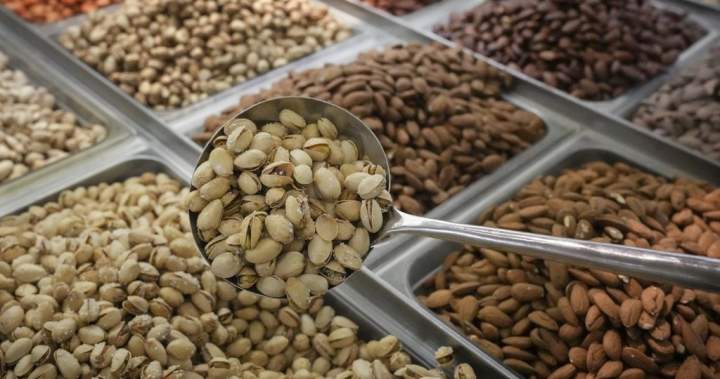
The number of pistachios and pistachio-containing products being recalled across Canada due to potential salmonella risks continues to grow, with more than 80 cases reported in the past week and a half alone.
A total of 84 products were recalled between November 12 and November 24, ranging from roasted salted pistachios and raw pistachios to pistachio eclairs and baklava.
The various products were sold in stores in seven provinces: British Columbia, Alberta, Manitoba, Ontario, Quebec, New Brunswick, and Newfoundland and Labrador, and some were also sold online.
This recall is part of an ongoing food safety investigation that the Canadian Food Inspection Agency (CFIA) initiated on July 24 with Habibi brand pistachio grains.
The CFIA confirmed to Global News on Tuesday that the pistachios involved in the recall were imported from Iran, but did not say whether they came from a specific crop.
The agency says additional secondary recalls have since been issued for various products manufactured using the recalled pistachios and due to additional testing activity supporting the investigation.
At the end of September, as a result of its investigation, the CFIA announced that it would temporarily restrict imports of pistachios and pistachio-containing products from Iran as a precautionary measure.
All importers of products must provide evidence that their products do not originate in Iran in order to be accepted, or the products may be refused entry or subject to a “holding test” for salmonella.
Lawrence Goodridge, a food safety professor at the University of Guelph, told Global News that although it is possible to trace the initial product, it is possible that pistachios were being sold in large quantities which led to so many recalls.
“The problem is, why there are so many different recalls going on, is that pistachios can be sold in large quantities,” he said. “I mean, I don't know where it came from… It's very hard to remember because no one knows where it came from. It's not on the label, it's not on the package.”

He added that given pistachios' long shelf life, Canadians could keep pistachios in their homes or businesses that were purchased some time ago but are still in circulation.
The recent recall also included pistachios sold in October 2024.

Get weekly health news
Get the latest medical news and health information every Sunday.
The CFIA notes that its investigation includes sampling and testing at various stages along the supply chain, and that it is working with industry to ensure recalled products are removed.
“Pistachios have a long shelf life and can remain on the market for many months,” the CFIA said in its investigation notice. “If other products on the Canadian market are determined to be affected, the CFIA will publish recall information on the Recalls and Safety Alerts website and issue food recall alerts as appropriate.”
From Dubai-style chocolate bars to a variety of pastries, pistachios have become increasingly popular in recent months.
Estimates from Cognitive Market Research conducted earlier this year suggest that sales revenue in Canada is expected to exceed $500 million in 2025.
The 84 recalled products were one of the highest numbers of products listed in a single notice, but 68 separate recalls have been issued since July.
At least 130 products have been recalled this month alone.

current trends

14 MLAs in the Alberta government are facing recall efforts. what happened?

Polar vortex brings 'beginning of harsh winter' across Canada
Salmonella outbreak also under investigation
The Public Health Agency of Canada is conducting its own investigation into an outbreak of Salmonella infections linked to pistachios and pistachio-containing products, and says 117 people have become ill.
The notice states that between March 2025 and the end of September 2025, there have been numerous reports of people getting sick and getting sick from eating pistachios or products containing pistachios.
Should Canadians avoid pistachios?
Goodridge said people may want to avoid the product for the time being, given the continuing outbreak.
“If you know where the pistachios come from, it's okay to buy them, as long as they're not from Iran,” he says. “Realistically speaking, the best advice is to refrain from consuming pistachios until this outbreak is over.
But because many companies sell products containing the nut, and restaurants may have used the nut in baked goods, Goodridge said Canadians shouldn't be excluded from eating or purchasing the product just because it's named in the recall.
“Another thing to consider is that the vendor may not know where it's coming from either,” he says. “If people are going to order something, I think it's fair to ask if the product has pistachios in it. If so, does the restaurant know where the pistachios come from? Then they can decide whether to consume it, order it, consume it or not.”
Health Details More Videos
© 2025 Global News, a division of Corus Entertainment Inc.