

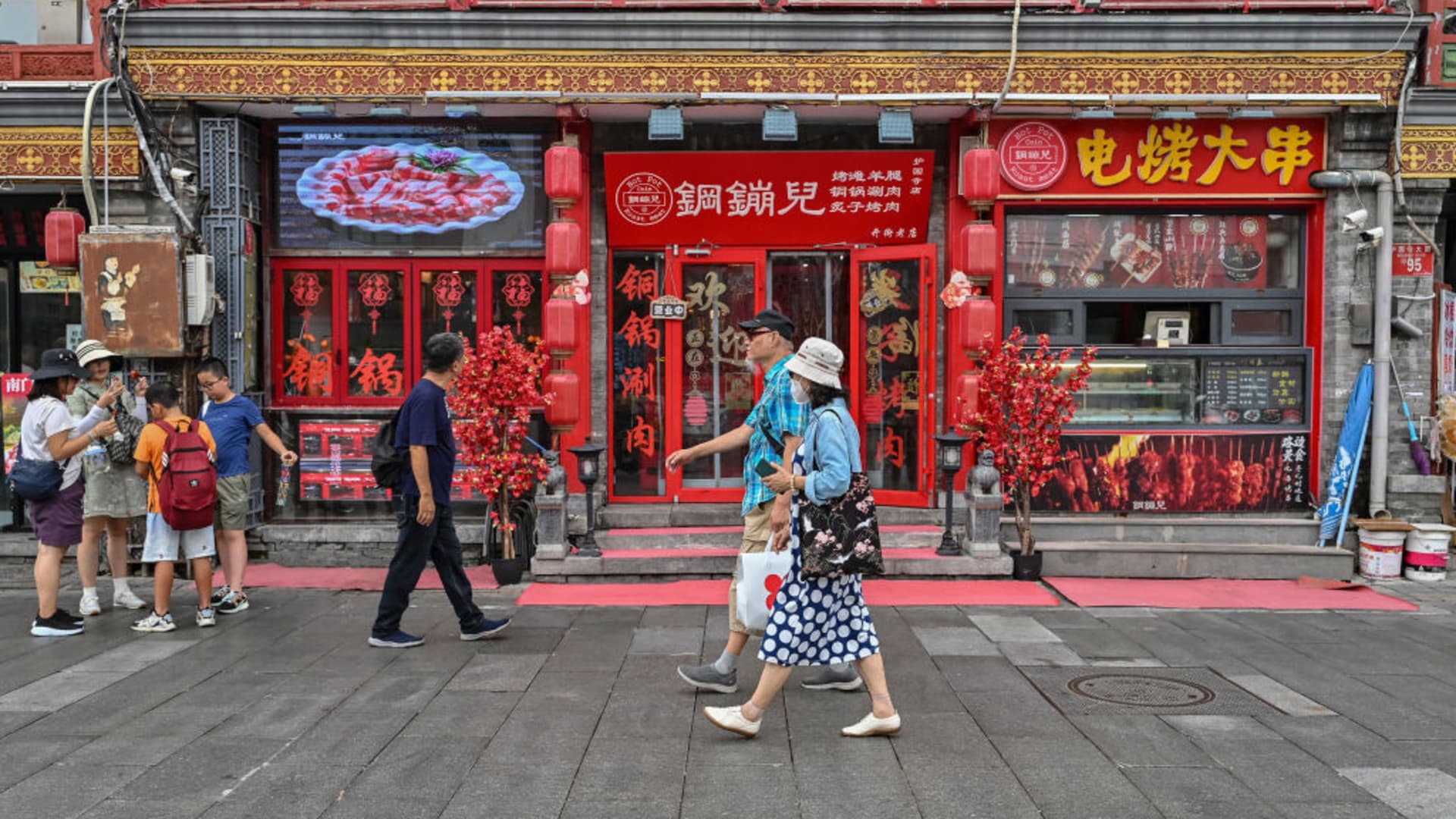
On August 23, 2024, people walk along Huguo Street in Xicheng District, Beijing's food and beverage district.
Adek Berry | AFP | Getty Images
China's consumer inflation rate rose in November to its highest level in nearly two years, while producer price deflation deepened, underscoring the challenge policymakers face in restoring domestic demand as trade tensions persist.
Consumer prices rose 0.7% year-on-year, the highest level since February last year, data from the Office for National Statistics on Wednesday showed. This followed a 0.2% rise in October and was in line with expectations for a 0.7% rise in a Reuters poll of economists.
Factory gate prices in November fell 2.2% compared to the same month last year, but this was mainly due to a high comparison standard, missing the 2% drop forecast, and deflation entering its fourth year. The decline followed a 2.1% decline in October.
Core inflation, which excludes volatile food and energy prices, rose 1.2% in November from a year earlier, unchanged from the previous month's rate of increase.
NBS chief statistician Don Lijuan said the improvement in CPI was due to higher food prices, which rose 0.2% year-on-year, reversing the 2.9% decline in October. Energy prices fell 3.4% year-on-year, a sharp drop compared to the previous month.
Prices of home appliances and clothing continued to rise due to the Chinese government's consumption-oriented stimulus measures, rising by 4.9% and 2%, respectively. Prices of gasoline vehicles and new energy vehicles fell by 2.5% and 2.4%, respectively. Gold accessory prices rose 58.4% from the previous year.
On a monthly basis, CPI fell 0.1%, below the 0.2% rise expected in a Reuters poll, as prices for hotels, flights, transportation and travel agents cooled after the October long holiday.
Among the categories that recorded the sharpest decline in ex-factory prices, the coal mining and cleaning industry saw prices fall by 11.8% year-on-year, while the oil and gas extraction sector recorded a 10.3% decline.
growth slows
Economists warned that deflationary pressures on the world's second-largest economy will continue into next year as a prolonged housing recession and weak labor market continue to weigh on household spending, pointing to the need for further policy support.
Although economic growth slowed in the third quarter to its slowest pace in a year, China appears on track to meet this year's annual growth target of about 5%, supported by strong exports as manufacturers ramp up shipments to markets outside the United States.
China posted a trade surplus of more than $1 trillion in the first 11 months of this year, surpassing the full-year record set in 2024, as it navigates ongoing trade tensions and rising economic protectionism around the world.
At a key meeting earlier this month, the ruling Communist Party's highest decision-making body, the Politburo, named expanding domestic demand and rebalancing supply as its top economic priorities for 2026.
“Policymakers maintained their easing bias, but appeared less inclined toward broader stimulus,” said Lishen Wang, China economist at Goldman Sachs, noting that policymakers may need to re-intensify easing rhetoric and ramp up pro-growth policy efforts next year to offset the impact on the real estate sector and labor market.
Investors and economists are closely watching the annual Central Economic Work Conference in coming days, where policymakers will set key growth targets and policy priorities for next year. Official statistics will not be published until the annual parliament in March.