

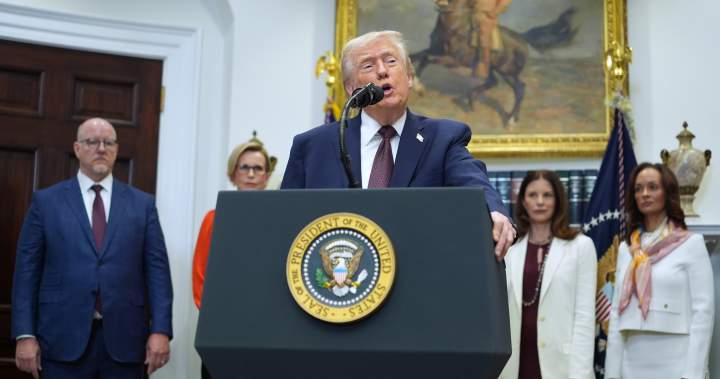
President Donald Trump and nine major drug companies on Friday announced a deal to lower the prices of their drugs for the government's Medicaid program and cash payers, in the latest effort to bring U.S. health care costs in line with those in other wealthy countries.
Bristol-Myers Squibb, Gilead Sciences, Merck & Co. and Genentech, the U.S. division of Roche, have signed an agreement. Novartis, Amgen, Boehringer Ingelheim, Sanofi and GSK also signed.
“We were giving subsidies to the whole world. We're not going to give them anymore,” Trump said at a White House press conference surrounded by nine pharmaceutical executives.
Mehmet Oz, director of the Centers for Medicare and Medicaid Services, said three companies, Regeneron, Johnson & Johnson and AbbVie, will visit the White House after the holidays to launch the government's TrumpRx website.
Under the deal, drug companies will reduce the prices of most drugs they sell to low-income Medicaid programs, officials said, pledging “significant savings” on widely used drugs without providing specific numbers.
U.S. patients currently pay by far the most for prescription drugs, often nearly three times as much as in other developed countries, and President Trump is pressuring drug companies to lower prices to what patients would pay in other countries.
Details of each agreement were not immediately available, but officials said they include lower cash-pay direct-to-consumer prices for some drugs that could be sold through the TrumpRx.gov website, an agreement to launch drugs in the U.S. at prices comparable to (but not less than) prices in other wealthy countries, and to increase manufacturing. In return, companies will be exempted from all customs duties for three years.

Merck's Januvia, Trumpx's Janumet
Merck announced that it will sell its diabetes drugs Januvia, Janumet, and Janumet XR, which are expected to face generic competition next year, directly to U.S. consumers at about 70% off the list price. If approved, its experimental cholesterol drug ensitide would also be available through direct-to-consumer channels.

Get weekly health news
Get the latest medical news and health information every Sunday.
Enlisitide is one of two Merck drugs expected to receive expedited review under the FDA's new fast-track pathway, Reuters previously reported.
Amgen announced it is expanding its direct-to-patient program to include migraine drug Aimovig and rheumatoid arthritis drug Amjevita, offering both for $299 per month. This is nearly 60% and 80% cheaper than the current list price in the United States.
current trends

Tax season is still a few months away. 3 things you do now that could help you later

Influenza hospitalizations soar as H3N2 spreads across Canada
In July, President Trump sent a letter to the leaders of 17 major drug companies, asking them to offer so-called most-favored-nation prices for Medicaid, and to release new drugs at prices that do not exceed prices in other rich countries.
Five companies have so far signed contracts with the government to keep prices down: Pfizer, Eli Lilly, AstraZeneca, Novo Nordisk and EMD Serono, the U.S. arm of Germany's Merck KGaA.

The remaining three companies that have not announced deals are Regeneron, Johnson & Johnson, and AbbVie. Investors were initially concerned about strict price controls in the United States, but details of recent transactions have largely allayed those concerns. Reuters previously reported that AbbVie planned to announce the acquisition on Friday.
Pharmaceutical companies on Friday committed to “most-favored-nation” pricing for all new drug launches in the U.S. across commercial, government and cash-pay markets, including the U.S. Medicare program for people 65 and older, officials said.
A portion of each company's overseas sales will also be sent to the United States to offset costs, the people said.
The companies have jointly committed to investing more than $150 billion in research, development and manufacturing in the United States, officials said, but it is unclear whether that includes previous commitments. Some have also agreed to donate pharmaceutical raw materials to the U.S. Strategic Reserve.
Merck said it invested $70 billion of that amount.
Analysts note that Medicaid, which accounts for only about 10% of U.S. drug spending, already benefits from deep price discounts, exceeding 80% in some cases.
Pfizer, which released its 2026 financial outlook on Tuesday, said Medicaid discounts would lead to price and profit margin compression next year.
World Details More Videos