

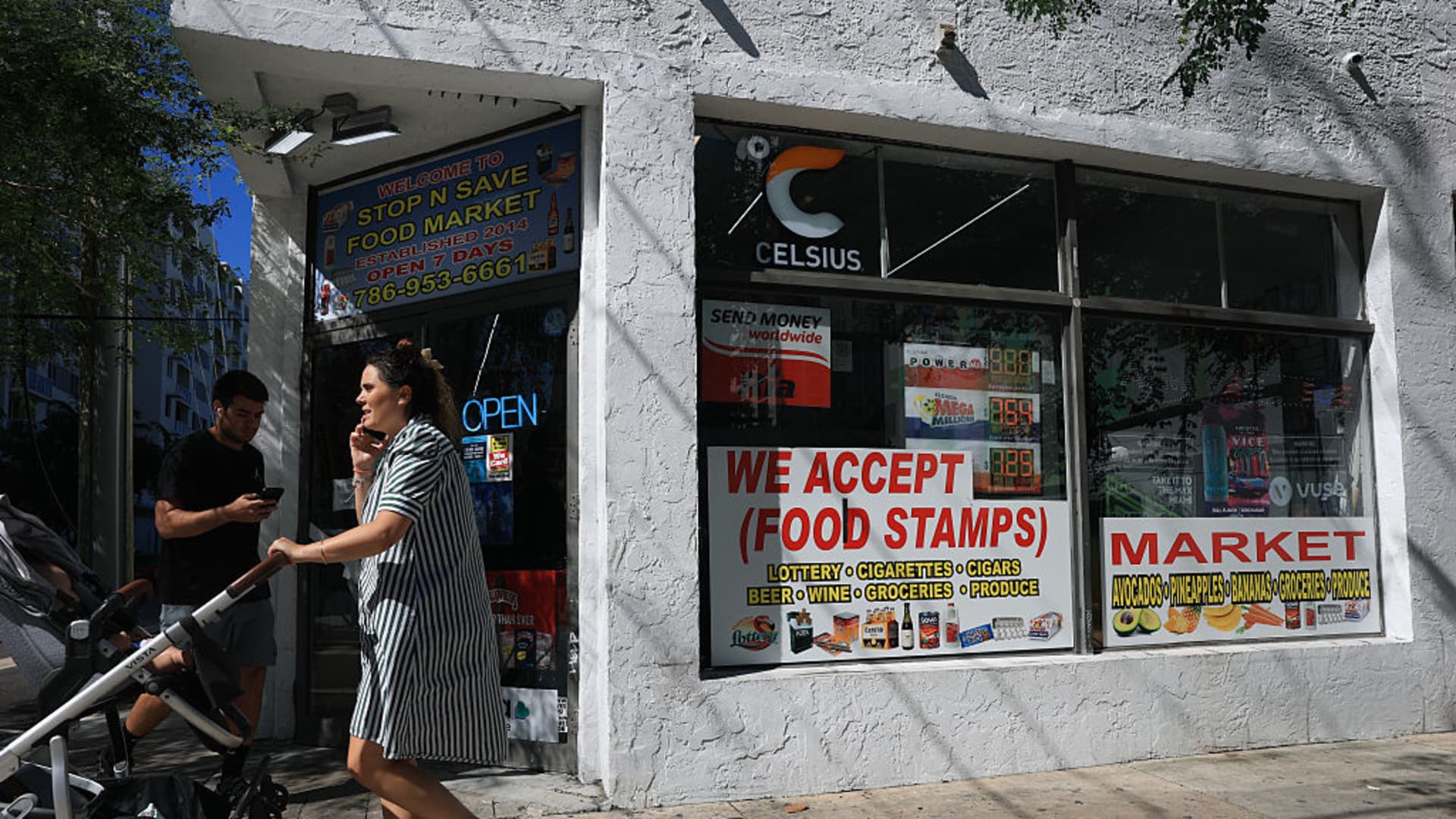
MIAMI, FL – OCTOBER 31: A “We Accept (Food Stamps)” sign is posted in the window of a grocery store on October 31, 2025 in Miami, Florida. The food stamp program, now known as the Supplemental Nutrition Assistance Program (SNAP), is now in its second month, with funding likely to run out on Nov. 1 due to the federal government shutdown. In Miami-Dade County, nearly one in six residents receives food assistance. (Photo by Joe Radle/Getty Images)
Joe Radle | Getty Images News | Getty Images
The Supreme Court on Friday night temporarily put on hold a federal judge's order directing the Trump administration to pay out November's full SNAP benefits to 42 million Americans by the end of the day.
The move came hours after the U.S. Court of Appeals for the 1st Circuit in Boston denied the administration's emergency request to suspend the order regarding food stamp benefits, primarily for low-income people.
But the appeals court also said it expects to rule soon on whether the administration has the right to put the order on hold while an appeal of the order proceeds, by Judge Jack McConnell of the U.S. District Court for Rhode Island.
In a pro-administration order Friday night, Supreme Court Justice Ketanji Brown Jackson asked the First Circuit to quickly decide whether to issue an injunction.
“The petitioners claim that, absent this court's intervention, they would have to 'transfer an estimated $4 billion by tonight' to fund SNAP benefits through November,” Jackson wrote.
The money would come from the so-called Section 32 fund, which the Trump administration had said it did not want to use to fund federal officials' planned increases in SNAP benefits. Partial benefit payments would come from a $4.6 billion emergency fund set aside by Congress for that purpose.
The government originally planned not to pay out SNAP benefits in November due to the ongoing government shutdown.
“Given the First Circuit's representations, an administrative stay is necessary in order for the First Circuit to expeditiously resolve the pending stay motions,” Jackson wrote.
He said the Supreme Court's stay “will end 48 hours after the First Circuit resolves the pending motion. The First Circuit is expected to forward the motion.”
The two-day grace period would give the Trump administration and the plaintiffs in the case time to return to the Supreme Court and challenge the First Circuit's decision.
It's unclear how much Jackson's order will affect SNAP benefit payments.
The U.S. Department of Agriculture told states early Friday that it would begin disbursing full SNAP benefits to comply with McConnell's order, even though the administration is appealing the ruling.
The USDA memo did not suggest that the administration would scrap the plan even if the high court blocked the order.
The Associated Press reported late Friday that more than six states “confirmed on Friday that some SNAP recipients had already received their November payments.”
“This decision is a tragedy for the millions of Americans who rely on SNAP to support their families,” New York Attorney General Letitia James said in a statement about Jackson's order.
“It is shameful that the Trump administration has chosen to fight this in court instead of fulfilling its responsibility to the American people,” James said. The state is also one of the plaintiffs in another pending lawsuit seeking to force full payment of SNAP benefits.
“The federal government’s delays will bring us another day when children, seniors, and families face real pain and suffering.”
The administration announced last week that it would not pay out SNAP benefits in November, citing the federal government shutdown that began Oct. 1 after Congress failed to pass a bill that would provide short-term funding for federal programs, including food stamps.
Past administrations have paid benefits during other government shutdowns.
A group of plaintiffs, including the city, labor unions, nonprofit organizations and retailers, then sued the administration in Rhode Island federal court, asking that McConnell be ordered to pay the full amount of benefits for the month.
On October 31, Mr. McConnell ordered his administration to use a rainy day fund to disburse at least a portion of SNAP benefits as soon as possible.
He also ordered his administration to consider whether other pools of previously allocated funds could be used to fully fund SNAP, which costs about $8 billion per month.
The administration announced Monday that it will use reserve funds to pay out 50% of SNAP benefits in November. But it refused to use an additional $4 billion from the Section 32 fund that would have made up the difference in SNAP payments.
Two days later, the administration announced that a recalculation found that 65% of SNAP benefits could be paid from emergency funds.
The plaintiffs then asked McConnell to order the administration to pay SNAP in full from available funds.
The judge ruled Thursday, calling the administration's decision to exclude Section 32 funding “arbitrary and capricious” during a hearing.
“People have gone without for far too long,” McConnell said.
In his order, he said that if SNAP is not adequately funded, “evidence shows that people go hungry, food pantries are overburdened, and unnecessary suffering occurs.”
On Friday morning, the administration asked the First Circuit Court of Appeals to block McConnell's order, even though the USDA issued a memo to states saying it intended to comply with the ruling.
On Friday night, a three-judge panel of that appeals court rejected the administration's request.
“The government does not dispute (federal law) that Section 32 funds can be used to provide November SNAP benefits,” the committee noted.
But the committee also said that “the government's motion to suspend appeal (of Mr. McConnell's order) remains pending, and we intend to issue a decision on that motion as soon as possible.”